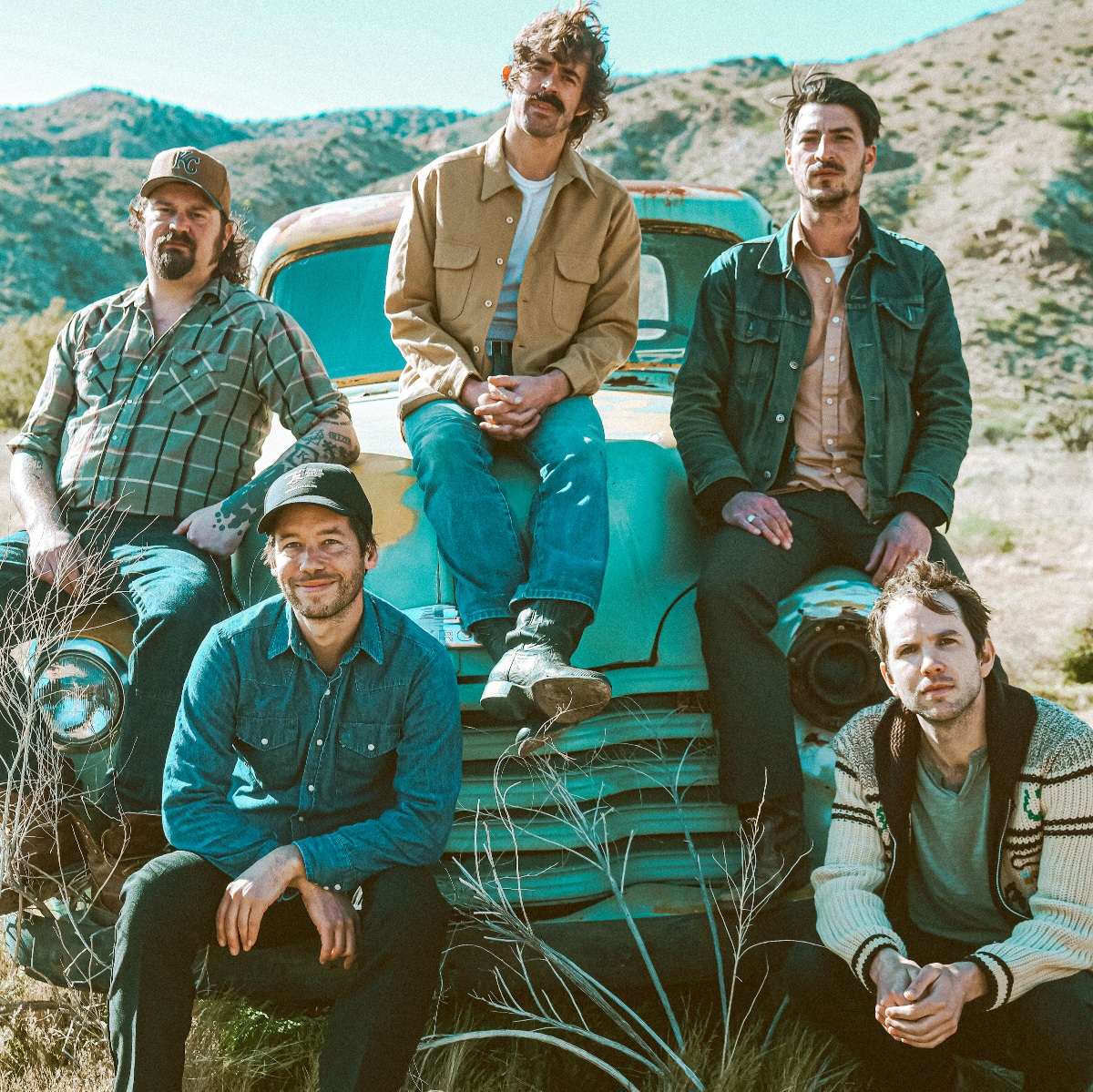
When the Deslondes recorded their new covers album, they didn’t want to simply exalt their heroes and catalog their influences. They wanted to give their friends a boost as well. The poignant and powerful Don’t Let It Die Vol. 1 includes new interpretations of old songs by artists who’ve guided the band for years, including Swamp Dogg, Johnny Cash, and Clifton Chenier, alongside new songs by peers, tourmates, and collaborators, including Nick Woods, Pat Reedy, and the Kernel. “We have so many friends who are songwriters, and we just love their music so much,” says John James Tourville, who plays guitar and occasionally the fiddle. “Riley and Dan are always kicking around awesome, inspiring old songs for us to do, but for this album we really wanted to do some friend songs, too.”
Don’t Let It Die maps out a community of likeminded musicians given to hopping trains, crowding tour vans, and blurring the lines between styles and scenes. “These songs are very much a close part of our lives,” says Riley Downing, who sings and usually plays guitar. “They’re all part of our circle, this big organism that keeps influencing itself. It’s mysterious, though, which musicians get heard and which ones don’t. I think we’re in a good position to tip our cap to the friends we look up to, and hopefully it will benefit our buddies. Hopefully this album will encourage people to go down those rabbit holes.”
Opening with the nuclear-fallout lament “The World Beyond” (by r&b eccentric Swamp Dogg) and ending with the pleading “Don’t Let It Die” (by the English producer/engineer Hurricane Smith), the album is a full-circle moment, one that takes them back to the very beginnings of the band and reasserts exactly why they do what they do. That makes it much more substantial than a typical covers stopgap. Don’t Let It Die is full of hellos and goodbyes, sad departures and cathartic arrivals, as befits a band whose members are away as much a they’re back home. “I was born a rambler, and I’ll die a rambler,” Downing sings on a spare version of Kiki Cavazos’ wanderlust anthem “I’m Gone,” as the band add crackling guitars and slow-rolling rhythms but leave a lot of open space around the melody. They move gracefully into Chenier’s hymnlike “I’m Coming Home” and then “Family,” an ode to restlessness by the Nashville-based singer-songwriter Nick Woods.
Each band member brought in a handful of songs to consider, but one of the shoo-ins was the modest-yet-profound “I’m Gone,” which figures prominently in Deslondes lore. Cavazos is something of a legend in New Orleans, a founding member of the hugely influential but sadly undercelebrated Sundown Songs. “They were incredibly important to us,” says Doores, “because they had a bunch of different songwriters who were doing things individually but also were bringing each other’s songs to life. That was the model for the Deslondes. Beyond that, Kiki was my first friend when I came to town back in 2006, and ‘I’m Gone’ was the first song I ever heard her play. We were trading songs on the riverbank, and she played the most amazing song I’d ever heard.”
A few years after that fateful exchange of songs, Doores moved down to Deslonde Street in the Ninth Ward, which at the gime was largely abandoned. Surrounded by levees, the neighborhood felt remote and unclaimed: their own little corner of a city renowned for its music history. He and his friends could make all the music they wanted and not piss off the neighbors, because there weren’t any neighbors. “We’d all hang out around the fire in the backyard and trade songs,” says Doores. “Deslonde became a hub for our little misfit community of traveling musicians.” Gradually, a band took shape and called themselves the Tumbleweeds. They made music constantly, and their earliest efforts, known to fans as the Mashed Potato Recordings, include a number of covers. But there was one problem: There was another band with a legal claim to the name the Tumbleweeds. They guys looked out the window, saw the street sign at the corner, and rechristened themselves the Deslondes.
Nearly 20 years later, the band members are scattered around the country—Downing lives up in Missouri, Tourville is out in North Carolina—but Doores still lives on Deslonde and has built a small studio in the house across the street. The band convened there in January 2025 to record this set of covers, and they quickly realized it was a historic event: While the place brough them together, they had never actually recorded on Deslonde as the Deslondes. “It felt so good to be in there again,” says Tourville. “There were barges and boats going by, people walking their dogs on the levees. The neighborhood is still very much alive, and the sessions were very loose and casual.” Another historic event: On the first day of recording, a fluke blizzard hit New Orleans and dumped more snow than the city had seen in a century. It was unexpected, but not unwelcome. “We were marooned there for a week,” Dan Cutler laughs. “That turned out to be great because otherwise we would have been distracted by friends or going out or whatever. We were all stuck inside together, but everything felt very cozy and comfortable.”
They recorded constantly, throughout the day and even the night, whenever the spirit hit them. Tourville recalls starting “Don’t Let It Die” at 4 AM: “I was completely exhausted, but Sam sings that song and he was feeling inspired. You have to strike while the iron’s hot. We got two guitar tracks and his lead vocal by 5 o’clock. Then the tape started acting weird, which was nerve-wracking. The power in New Orleans can be super crazy and case phase issues. It was a gamble recording on tape.” But the gamble paid off, as Don’t Let It Die crackles with live energy, showcasing each band member’s personality. Even upbeat songs like Edgar Blanchard’s “Lawdy Mama” (sourced from an old 45 Downing has treasured for most of his life) sound intimate and direct, as though you’re hanging out in that house on Deslonde with the band and all their friends.
And yet, Don’t Let It Die looks outward to survey the wider world beyond the Ninth Ward. As they chose songs for the album, they didn’t quite realize what they were creating: Together these songs all sound relevant to this particular moment in history, when the world seems to teeter on the brink of destruction. The first side offers visions of apocalypses both big and small, not just Swamp Dogg’s “The World Beyond” but also Johnny Cash’s ghost-town story-song “The Ballad of Boot Hill” and the Drunken Prayer’s small-town eulogy “Cordelia.” “That all naturally influenced our song choices,” says Doores. “It wasn’t planned, but we definitely gravitated toward songs that felt relevant to the times we’re in right now. And that’s something I truly love about our band. We have this weird subconscious hivemind thing that none of us fully understands, but it does come together in a unified vision.”
That makes their early-morning recording of the title track all the more crucial. “The irony isn’t lost on us that these songs are very relevant today,” says Tourville. “But ending with ‘Don’t Let It Die’ felt hopeful. We’re not an overtly political band, and we’re not trying to preach to anybody, but that felt like the right vibe.” Don’t Let It Die opens with the world ending and closes with a new beginning, one that reasserts the band’s values and embraces their community more closely. And that title promises more volumes of covers to come. Says Downing, “It was refreshing to do something different. It could be cool to keep doing it, maybe do more of these between studio albums, just to keep us inspired and focused on what’s important. It feels like a good way to keep making music and moving forward.”